



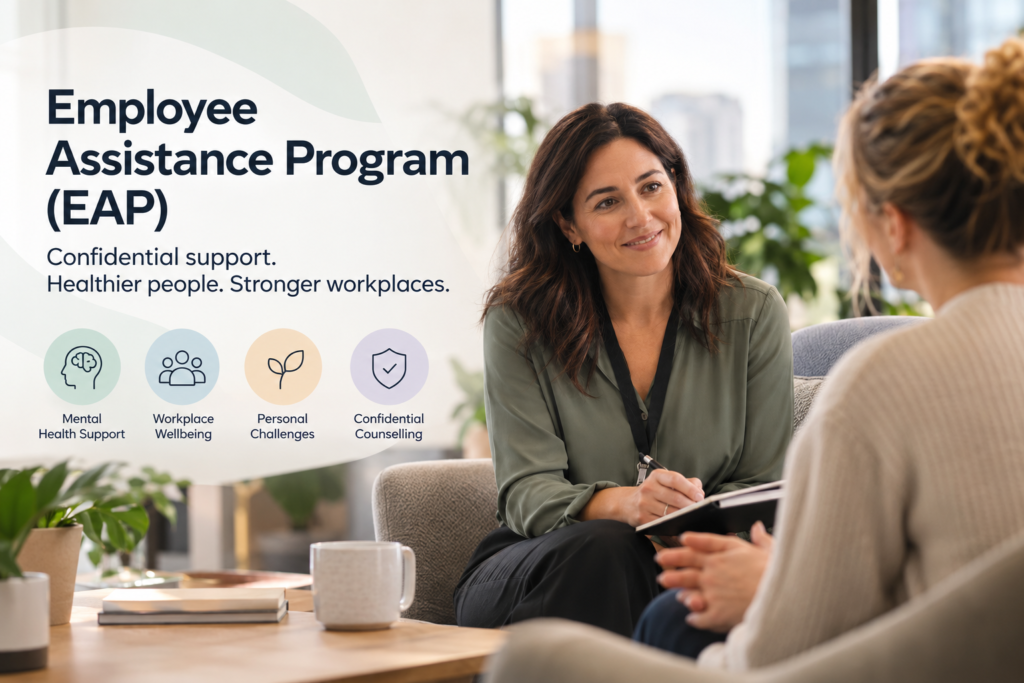
What Is an Employee Assistance Program (EAP)? A Guide for Australian Employers
Supporting employee wellbeing has become an increasingly important part of creating a healthy and sustainable workplace.
Employees may experience stress, anxiety, burnout, relationship difficulties, grief, workplace conflict or challenges outside of work that can affect how they feel and function.
An Employee Assistance Program (EAP) gives employees access to confidential professional support when they need someone to talk to.
For employers, an EAP can provide a simple and practical way to make counselling and mental health support available without employees needing to navigate the process on their own.
But what exactly is an EAP, how does it work, and what should Australian employers consider when choosing a provider?
What is an Employee Assistance Program?
An Employee Assistance Program, commonly known as an EAP, is a workplace support service that gives employees access to confidential counselling and other professional support.
In Australia, the Fair Work Ombudsman describes an EAP as a confidential counselling service that may be provided free to employees through their workplace.
Depending on the EAP provider and the organisation’s plan, employees may be able to seek support for both work-related and personal concerns.
This could include:
Stress and anxiety
Burnout and emotional exhaustion
Depression or low mood
Relationship and family difficulties
Grief and loss
Workplace conflict
Bullying or difficult workplace experiences
Major life changes
Parenting challenges
Personal wellbeing concerns
The aim is to provide employees with a safe and confidential space to talk through what they are experiencing and explore practical ways forward.
How does an EAP work?
The exact process varies between providers, but a modern EAP can be relatively straightforward.
An employer establishes an EAP service for its workforce. Employees are then given information explaining how they can access support.
When an employee needs help, they can generally contact the EAP provider directly and arrange a counselling session.
This separation between the employer and the counselling process is important.
Employees need to feel confident that seeking support will not negatively affect their employment or result in the details of their conversations being shared unnecessarily with their employer.
Confidentiality is therefore one of the foundations of an effective EAP.
Is EAP counselling confidential?
In normal circumstances, counselling sessions through an EAP are confidential.
The employee’s personal concerns and the content of their counselling sessions are not ordinarily provided to their employer.
There can be limited exceptions to confidentiality, such as circumstances involving serious and imminent safety concerns or where disclosure is required by law. The counsellor or EAP provider should explain these limits clearly.
For employers, this means EAP reporting should generally focus on broad utilisation information rather than revealing what individual employees have discussed.
Creating that sense of trust is essential.
If employees believe their manager will find out what they said in counselling, they may be much less likely to use the service.
What can employees use an EAP for?
One misconception about Employee Assistance Programs is that they are only for serious mental health problems.
They are not.
Employees can benefit from speaking with a counsellor well before a problem reaches crisis point.
For example, an employee might use EAP counselling because they are struggling with workload, feeling overwhelmed, experiencing difficulties at home, dealing with grief or simply noticing that they are no longer coping as well as they normally would.
Early support can give someone an opportunity to understand what is happening, develop coping strategies and decide what further support may be appropriate.
EAP can therefore be useful across a broad spectrum of situations rather than being something employees should only access when things have become severe.
Why do businesses offer an Employee Assistance Program?
There are several reasons an organisation may decide to provide an EAP.
1. Giving employees easier access to support
People often know they need support but delay seeking it.
They may not know who to contact, worry about cost or simply keep putting it off.
An EAP creates a clear pathway.
Instead of searching for help from scratch, employees already know where they can turn.
2. Supporting employees through difficult periods
Personal problems do not automatically disappear when someone arrives at work.
Relationship breakdowns, grief, financial stress, family difficulties and mental health concerns can all affect a person’s emotional wellbeing.
Providing professional support acknowledges that employees are people first.
3. Supporting workplace wellbeing
A healthy workplace requires more than productivity targets and policies.
Employees also need appropriate support, clear communication, healthy work design and an environment where concerns can be raised.
An EAP can form one part of that broader wellbeing strategy.
4. Providing managers with somewhere to refer employees
Managers are often among the first people to notice that an employee is struggling.
But managers are not therapists.
An EAP gives managers an appropriate professional service they can suggest when an employee needs more support than a workplace conversation can provide.
EAP and psychosocial hazards: an important distinction
EAP services can be valuable, but they should not be treated as the organisation’s entire workplace mental health strategy.
Australian workplaces also have responsibilities around managing psychosocial hazards.
Safe Work Australia identifies examples such as excessive job demands, low job control, poor support, lack of role clarity, bullying, harassment, workplace conflict and exposure to traumatic events.
Importantly, providing counselling or an EAP does not replace an employer’s responsibility to identify and manage psychosocial risks in the workplace. Safe Work Australia specifically notes that wellbeing initiatives such as counselling and EAP services respond to harm but do not, by themselves, satisfy the duty to eliminate or minimise psychosocial risks.
Think of EAP as one part of a broader approach.
A business should consider both:
Prevention: identifying and reducing workplace factors that may cause psychological harm.
Support: making professional help available when employees need it.
The strongest workplace wellbeing strategies generally consider both.
What should an EAP include?
Not every Employee Assistance Program is structured in the same way.
When comparing EAP providers, employers may want to consider:
Qualified professionals
Employees should have access to appropriately qualified mental health professionals who are experienced in providing confidential support.
Easy access
If accessing the service is complicated, employees are less likely to use it.
A clear booking process and straightforward communication can make a significant difference.
Online and telehealth options
For organisations with remote employees, multiple locations or flexible working arrangements, online counselling can make EAP support much easier to access.
Confidentiality
Employees should clearly understand what information remains confidential and what, if anything, is reported to their employer.
Flexible support
People do not all experience the same challenges.
An effective EAP should be able to support a range of personal, emotional and workplace concerns rather than taking a one-size-fits-all approach.
Clear communication with employees
Simply purchasing an EAP does not mean employees will use it.
Organisations need to explain what the service is, how employees access it and reassure employees about confidentiality.
Choosing an EAP provider in Australia
When comparing EAP providers, price is naturally important, but it should not be the only consideration.
Ask how employees actually experience the service.
How quickly can they access support?
Who will they speak with?
Is the booking process simple?
Can sessions take place online?
How is confidentiality handled?
What happens if someone requires support beyond the scope of the EAP?
How is usage communicated to the organisation without compromising employee privacy?
A program that employees feel comfortable accessing is ultimately more valuable than one that exists only as a benefit listed in an HR document.
A more human approach to workplace support
Behind every organisation are people.
People experience stress. They lose family members. Relationships change. Work becomes overwhelming. Anxiety appears. Life becomes difficult.
Providing an Employee Assistance Program cannot remove every challenge employees will experience.
What it can do is make sure they do not have to navigate those challenges entirely alone.
At Resplora, we provide confidential EAP counselling designed to make professional mental health support simple and accessible for Australian workplaces.
Our approach focuses on providing employees with a safe space to talk, reflect and explore practical ways forward with qualified mental health professionals.
Whether you are a small business introducing an EAP for the first time or an organisation reviewing your current employee wellbeing support, we can help you explore an arrangement that fits your workforce.
Looking for an Employee Assistance Program for your organisation?
Talk to Resplora about EAP support for your employees and discover an approach designed around the needs of your workplace.