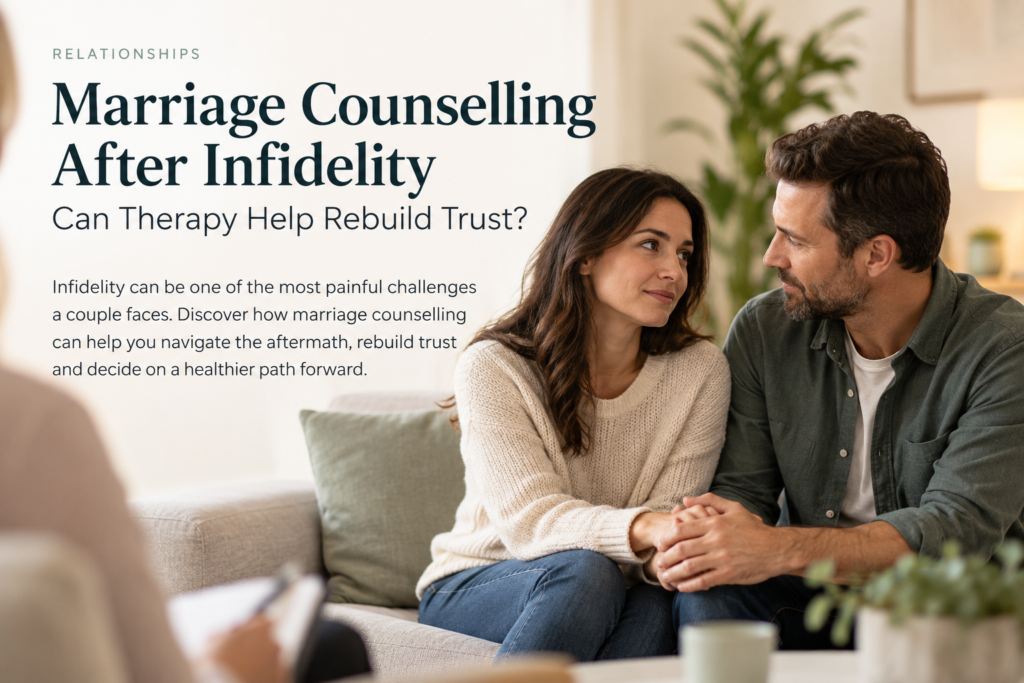
Discovering that your partner has been unfaithful can be one of the most painful experiences in a relationship. The emotional impact can be overwhelming, leaving you questioning everything you thought you knew about your partner, your relationship and your future together.
You might feel betrayed, angry, confused or deeply hurt. Perhaps you’re struggling with intrusive thoughts about what happened, finding it difficult to trust your partner or wondering whether your marriage can ever feel the same again.
If you’re experiencing these emotions, you’re not alone.
Infidelity can significantly affect the emotional connection between partners. However, while some relationships end following an affair, others find ways to heal, rebuild trust and create a healthier relationship.
Marriage counselling after infidelity can provide a supportive environment where couples explore what happened, understand their emotions and decide how they want to move forward.
But can therapy really help rebuild trust after cheating?
Let’s explore what the healing process might look like.
Understanding the Emotional Impact of Infidelity
Infidelity is rarely just about the physical or emotional involvement with another person.
For many individuals, the deepest pain comes from the loss of trust, emotional safety and the sense of security they once experienced in their relationship.
Following an affair, the betrayed partner may experience:
- Persistent feelings of sadness, anger or anxiety
- Difficulty trusting their partner
- Intrusive thoughts about the affair
- Changes in sleep or appetite
- Reduced self-esteem and confidence
- Fear of being betrayed again
- Difficulty concentrating on everyday activities
Meanwhile, the partner who was unfaithful may experience guilt, shame, confusion or fear about the future of the relationship.
These emotional responses can make communication particularly challenging.
One partner may desperately seek answers and reassurance, while the other may become defensive, withdrawn or overwhelmed.
Without effective communication, these patterns can create further emotional distance.
This is where professional relationship counselling may help.
Can a Marriage Survive Infidelity?
One of the most common questions couples ask after an affair is:
“Can our marriage ever recover from this?”
The answer depends on several factors, including the willingness of both partners to participate in the healing process.
Some couples successfully rebuild their relationships following infidelity, while others discover that separation is the healthiest path forward.
Neither outcome represents failure.
The purpose of marriage counselling is not necessarily to keep a couple together at all costs.
Instead, therapy aims to help both individuals understand their experiences, communicate more effectively and make informed decisions about their relationship.
For couples who wish to rebuild their connection, the process often involves acknowledging the emotional impact of the affair, taking responsibility for harmful behaviours and gradually restoring emotional safety.
Recovery is rarely immediate.
Rebuilding trust requires time, consistency and a genuine commitment to change.
How Marriage Counselling Helps After Infidelity
Marriage counselling offers a structured environment where couples can explore difficult emotions and conversations with the guidance of a trained professional.
Rather than assigning blame or deciding who is right or wrong, counselling focuses on understanding relationship dynamics and identifying healthier ways to communicate.
Here are five important areas that therapy may address.
1. Creating a Safe Space for Difficult Conversations
After infidelity, conversations can quickly become emotionally intense.
Questions about the affair may lead to arguments, defensiveness or emotional withdrawal.
A counsellor can help couples approach these conversations more constructively.
During counselling sessions, both partners have opportunities to express their feelings and perspectives while developing healthier communication patterns.
The goal is to create an environment where difficult emotions can be acknowledged without escalating conflict.
2. Understanding What Happened
Infidelity can occur within relationships for many different reasons.
These may include emotional disconnection, difficulties with intimacy, unmet expectations, poor boundaries or individual challenges.
However, understanding contributing factors does not mean excusing the betrayal.
The person who engaged in infidelity remains responsible for their choices.
Counselling can help couples explore the circumstances surrounding the affair while maintaining accountability and recognising the emotional impact on the betrayed partner.
This process may help both individuals develop a clearer understanding of their relationship.
3. Rebuilding Trust After Cheating
Trust is often one of the most difficult aspects of a relationship to restore following infidelity.
The betrayed partner may question whether their partner is being truthful, even about everyday situations.
Rebuilding trust involves more than simply promising that the affair will never happen again.
It generally requires consistent actions over time.
These may include:
- Demonstrating honesty and accountability
- Establishing clear relationship boundaries
- Following through on commitments
- Responding empathetically to emotional concerns
- Maintaining open communication
- Allowing sufficient time for healing
A counsellor can help couples identify what rebuilding trust means within their particular relationship.
Importantly, trust cannot be demanded or rushed.
It develops gradually through repeated experiences of reliability and emotional safety.
4. Improving Emotional Connection
Following infidelity, couples may struggle with emotional or physical intimacy.
The betrayed partner might feel uncomfortable being vulnerable, while the other partner may be uncertain about how to reconnect.
Marriage counselling can help couples explore these difficulties without pressuring either person to move faster than they feel comfortable.
Therapy may focus on improving emotional awareness, understanding each other’s needs and developing more supportive ways of interacting.
For some couples, this process creates opportunities to establish a different and healthier relationship dynamic.
5. Deciding Whether to Stay Together
Not every couple enters marriage counselling knowing whether they want to remain together.
Sometimes one partner wants to repair the relationship while the other is uncertain.
This uncertainty can be emotionally exhausting.
Counselling provides an opportunity to explore these feelings without immediately forcing a decision.
Couples may examine their values, expectations, emotional needs and hopes for the future.
In some situations, therapy supports reconciliation.
In others, it helps individuals navigate separation with greater clarity and respect.
The goal is to support informed decisions rather than pressure couples towards a particular outcome.
How Long Does It Take to Rebuild Trust After Infidelity?
There is no universal timeline for recovering from infidelity.
Some couples begin noticing improvements in communication relatively early, while rebuilding deeper emotional trust may take considerably longer.
The healing process depends on factors such as the circumstances of the affair, the level of emotional distress, the willingness of both partners to engage in counselling and whether harmful behaviours have stopped.
Progress may also be uneven.
A couple might experience several positive weeks followed by renewed feelings of anger, sadness or insecurity.
These emotional fluctuations do not necessarily mean that recovery is impossible.
However, they highlight the importance of patience and realistic expectations.
Rather than focusing exclusively on how quickly trust can return, it may be more helpful to consider whether both partners are consistently contributing to a safer and healthier relationship.
What If Only One Partner Wants Marriage Counselling?
It’s common for partners to have different levels of readiness when considering therapy.
One person may feel strongly that professional support is necessary, while the other may feel hesitant, embarrassed or unsure whether counselling will help.
If your partner is unwilling to attend, individual counselling can still be valuable.
Working with a counsellor individually may help you:
- Process difficult emotions
- Understand your personal boundaries
- Explore your relationship needs
- Develop emotional coping strategies
- Consider your options for the future
You do not need to wait for your partner to agree to counselling before seeking emotional support.
Individual therapy can provide clarity and help you make decisions that align with your wellbeing.
Is Marriage Counselling Worth It After Cheating?
Marriage counselling can be worthwhile when couples are struggling to navigate the emotional consequences of infidelity.
Professional support may be particularly helpful when:
- Conversations repeatedly turn into arguments
- Trust has become difficult to establish
- One or both partners feel emotionally disconnected
- The affair continues to affect everyday interactions
- You are uncertain whether to continue the relationship
- Both partners want to rebuild their connection but don’t know where to begin
However, counselling is not a guarantee that a relationship will survive.
It also may not be appropriate to begin joint counselling when there is ongoing coercion, intimidation or abuse. In those circumstances, individual support and safety planning may be more appropriate.
A counsellor can help assess whether couples counselling is suitable for your circumstances.
How to Start Healing After Infidelity
If you’ve recently discovered an affair, you may feel pressure to make immediate decisions about your relationship.
However, you don’t necessarily need to have all the answers right now.
Consider allowing yourself time to process your emotions and identify what you need.
Some helpful starting points include acknowledging your feelings without judgement, seeking support from trusted people, establishing healthy boundaries and avoiding pressure to forgive before you feel ready.
It can also be helpful to recognise that forgiveness and reconciliation are different processes.
You may eventually choose to forgive your partner without continuing the relationship.
Alternatively, you may decide to work towards rebuilding your connection.
Your healing journey is personal, and your decisions deserve to be respected.
Marriage and Relationship Counselling at Resplora
At Resplora, we understand that navigating infidelity can be emotionally challenging.
Whether you’re experiencing the pain of betrayal, struggling to rebuild trust or feeling uncertain about the future of your relationship, professional counselling can offer a supportive space to explore your experiences.
Our counselling services are designed to help individuals and couples better understand their emotions, improve communication and develop healthier relationship patterns.
We offer couples counselling and individual therapy, with online sessions available across Australia and in-person support on the Gold Coast.
Our approach is compassionate, collaborative and focused on your individual circumstances.
We recognise that every relationship is different, and there is no single solution that works for everyone.
Whether your goal is reconciliation, greater emotional clarity or navigating separation, counselling can help you explore the path that feels right for you.
Book your free 15 minutes session
Choose a therapist and claim your complimentary 15 minutes welcome session today
Common questions
Frequently Asked Questions About Marriage Counselling After Infidelity
Can marriage counselling really help after an affair?
Marriage counselling can help couples understand the emotional impact of infidelity, improve communication and explore ways to rebuild trust. However, outcomes vary depending on each couple’s circumstances and willingness to participate.
Can you rebuild trust after cheating?
Should we try couples counselling or individual therapy?
What happens during marriage counselling after infidelity?
Sessions may involve discussing the impact of the affair, identifying communication difficulties, exploring emotional needs and developing strategies to support healthier relationship interactions.